
Browsing Pathways
Showing 541111 -
541120 of 605359 pathways
| PathBank ID | Pathway Name and Description | Pathway Class | Chemical Compounds | Proteins |
|---|---|---|---|---|
SMP0729262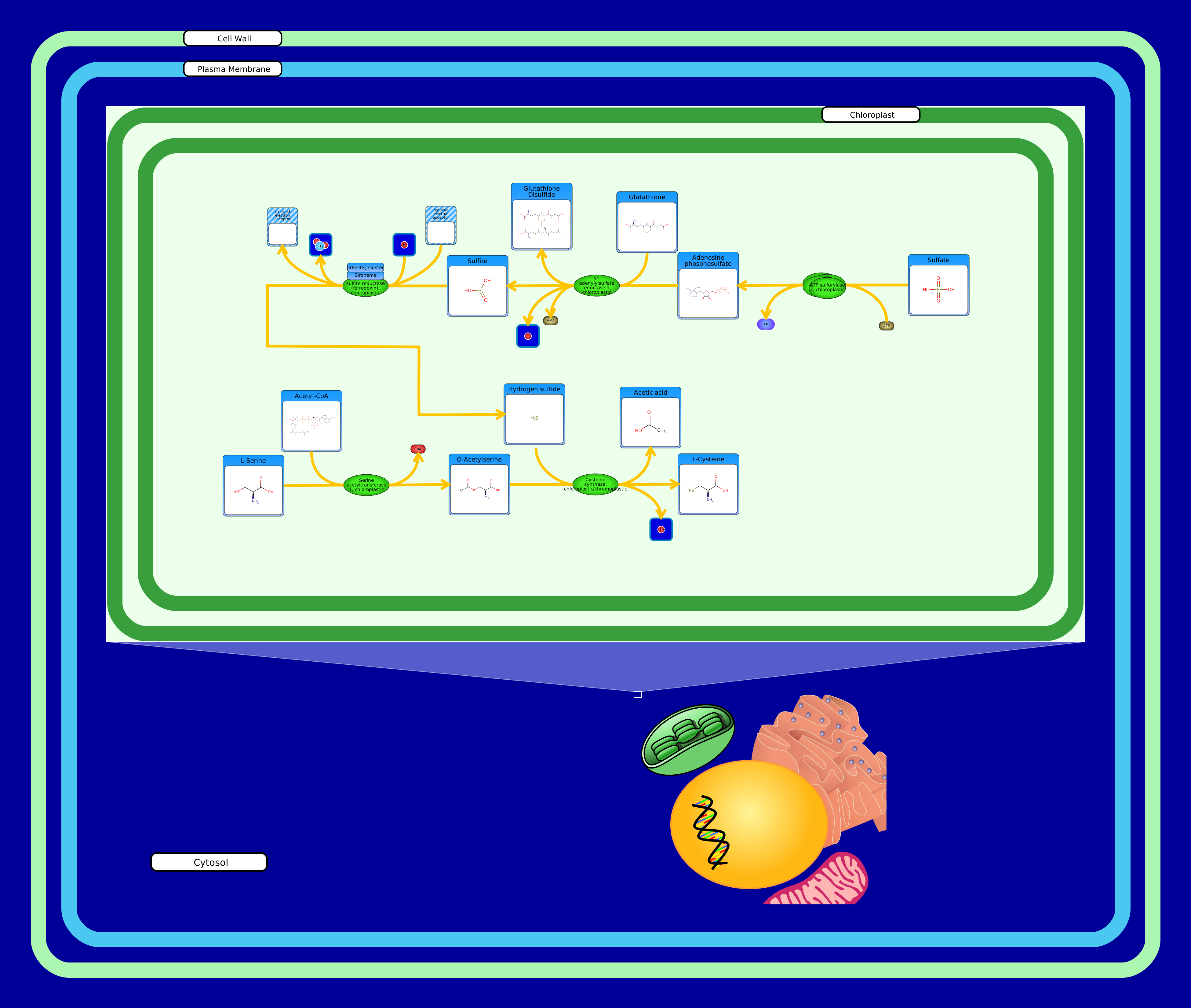 View Pathway
|
Cysteine BiosynthesisArabidopsis thaliana
In Arabidopsis thaliana, cysteine biosynthesis links sulfate assimilation with amino acid metabolism through a coordinated five-step pathway. The process begins with uptake and activation of inorganic sulfate, which is converted to adenosine 5′-phosphosulfate (APS) by ATP sulfurylase. APS is then reduced to sulfite by APS reductase and further reduced to hydrogen sulfide by sulfite reductase, providing the reduced sulfur needed for amino acid synthesis. In parallel, L-serine is activated by serine acetyltransferase to form O-acetylserine, which serves as the carbon–nitrogen backbone for cysteine. In the final step, O-acetylserine(thiol)lyase catalyzes the incorporation of hydrogen sulfide into O-acetylserine, producing L-cysteine. This pathway supplies cysteine as a central sulfur-containing amino acid required for protein synthesis, glutathione production, and sulfur-dependent metabolic processes in plants.
|
Metabolite
Metabolic
|
||
SMP0729264 View Pathway
|
Triacylglycerol Degradation 1770345845Arabidopsis thaliana
In higher plants, the primary seed storage reserve is triacylglycerol rather than carbohydrates. Thus, triacylglycerol degradation is an important pathway from which plants obtain energy for growth. First, triacylglycerol lipase, an enzyme localized to the oil body (storage vacuole) membrane, catalyzes the conversion of a triglyceride into a 1,2-diglyceride. Second, the predicted enzyme diglyceride lipase (coloured orange in the image) is theorized to catalyze the conversion of a 1,2-diglyceride iinto a 2-acylglycerol. Third, a 2-acylglycerol is spontaneously converted into a 1-monoglyceride. Fourth, acylhydrolase catalyzes the conversion of a 1-monoglyceride into glycerol. Fifth, glycerol kinase catalyzes the conversion of glycerol into glycerol 3-phosphate. Sixth, glycerol-3-phosphate dehydrogenase (coloured dark green in the image), localized to the mitochondrial inner membrane, catalyzes the conversion of glycerol 3-phosphate into glycerone phosphate.
|
Metabolite
Metabolic
|
||
SMP0729238
View Pathway
|
Triacylglycerol Degradation 1768495980Arabidopsis thaliana
In higher plants, the primary seed storage reserve is triacylglycerol rather than carbohydrates. Thus, triacylglycerol degradation is an important pathway from which plants obtain energy for growth. First, triacylglycerol lipase, an enzyme localized to the oil body (storage vacuole) membrane, catalyzes the conversion of a triglyceride into a 1,2-diglyceride. Second, the predicted enzyme diglyceride lipase (coloured orange in the image) is theorized to catalyze the conversion of a 1,2-diglyceride iinto a 2-acylglycerol. Third, a 2-acylglycerol is spontaneously converted into a 1-monoglyceride. Fourth, acylhydrolase catalyzes the conversion of a 1-monoglyceride into glycerol. Fifth, glycerol kinase catalyzes the conversion of glycerol into glycerol 3-phosphate. Sixth, glycerol-3-phosphate dehydrogenase (coloured dark green in the image), localized to the mitochondrial inner membrane, catalyzes the conversion of glycerol 3-phosphate into glycerone phosphate.
|
Metabolite
Metabolic
|
||
SMP0125361 View Pathway
|
Ubiquinone and other terpenoid-quinone biosynthesis 1636480163 1652153943Cannabis sativa
|
Metabolite
Metabolic
|
||
SMP0729243
View Pathway
|
Arabidopyrone BiosynthesisArabidopsis thaliana
|
Metabolite
Metabolic
|
||
SMP0729246
View Pathway
|
Fenugreek MetabolismRattus norvegicus
|
Metabolite
Physiological
|
|
|
SMP0729250
View Pathway
|
Amino Sugar and Nucleotide Sugar Metabolism IStaphylococcus aureus
The synthesis of amino sugars and nucleotide sugars starts with the phosphorylation of N-Acetylmuramic acid (MurNac) through its transport from the periplasmic space to the cytoplasm. Once in the cytoplasm, MurNac and water undergo a reversible reaction through a N-acetylmuramic acid 6-phosphate etherase, producing a D-lactic acid and N-Acetyl-D-Glucosamine 6-phosphate. This latter compound can also be introduced into the cytoplasm through a phosphorylating PTS permase in the inner membrane that allows for the transport of N-Acetyl-D-glucosamine from the periplasmic space. N-Acetyl-D-Glucosamine 6-phosphate can also be obtained from chitin dependent reactions. Chitin is hydrated through a bifunctional chitinase to produce chitobiose. This in turn gets hydrated by a beta-hexosaminidase to produce N-acetyl-D-glucosamine. The latter undergoes an atp dependent phosphorylation leading to the production of N-Acetyl-D-Glucosamine 6-phosphate.
N-Acetyl-D-Glucosamine 6-phosphate is then be deacetylated in order to produce Glucosamine 6-phosphate through a N-acetylglucosamine-6-phosphate deacetylase. This compound can either be isomerized or deaminated into Beta-D-fructofuranose 6-phosphate through a glucosamine-fructose-6-phosphate aminotransferase and a glucosamine-6-phosphate deaminase respectively.
Glucosamine 6-phosphate undergoes a reversible reaction to glucosamine 1 phosphate through a phosphoglucosamine mutase. This compound is then acetylated through a bifunctional protein glmU to produce a N-Acetyl glucosamine 1-phosphate.
N-Acetyl glucosamine 1-phosphate enters the nucleotide sugar synthesis by reacting with UTP and hydrogen ion through a bifunctional protein glmU releasing pyrophosphate and a Uridine diphosphate-N-acetylglucosamine.This compound can either be isomerized into a UDP-N-acetyl-D-mannosamine or undergo a reaction with phosphoenolpyruvic acid through UDP-N-acetylglucosamine 1-carboxyvinyltransferase releasing a phosphate and a UDP-N-Acetyl-alpha-D-glucosamine-enolpyruvate.
UDP-N-acetyl-D-mannosamine undergoes a NAD dependent dehydrogenation through a UDP-N-acetyl-D-mannosamine dehydrogenase, releasing NADH, a hydrogen ion and a UDP-N-Acetyl-alpha-D-mannosaminuronate, This compound is then used in the production of enterobacterial common antigens.
UDP-N-Acetyl-alpha-D-glucosamine-enolpyruvate is reduced through a NADPH dependent UDP-N-acetylenolpyruvoylglucosamine reductase, releasing a NADP and a UDP-N-acetyl-alpha-D-muramate. The latter is also involved in the D-glutamine and D-glutamate metabolism.
|
Metabolite
Metabolic
|
|
|
SMP0729275
View Pathway
|
presenilin 1 calcium signalingMus musculus
|
Metabolite
Signaling
|
|
|
SMP0729269
View Pathway
|
alpha- glucans pathwayHomo sapiens
Fungal α-Glucan (ligand): Presented on the fungal cell wall. It can (a) bind host receptors or (b) mask β-glucan.
Dectin-1/Mincle (host cell membrane): C-type lectin receptors on macrophages/DCs that bind α-glucan
. Engagement recruits Syk kinase (cytosol) and the CARD9–BCL10–MALT1 complex, activating NF-κB in the nucleus
.
NF-κB → Cytokines/DC maturation (nucleus): Active NF-κB drives transcription of pro-inflammatory cytokines (TNF-α, IL-12)
, leading to dendritic cell maturation (↑MHC-II/CD80/86) and Th1 polarization
. This completes the host innate immune response.
α-Glucan immune evasion: Fungal α-(1→3)-glucan in the cell wall (gray) physically shields underlying β-glucans, so Dectin-1 cannot detect them
. This prevents β-glucan–triggered PRR signaling (no arrow from β-glucan to Dectin-1).
Fungal GPCR–cAMP–PKA signaling: In fungal cells (green), α-glucan (or related stimuli) activates a Gα-coupled receptor (GPCR) on the fungal membrane. This triggers adenylyl cyclase → cAMP → PKA in the cytosol (green arrows)
. PKA phosphorylates transcription factors (nucleus), upregulating genes for metabolism, cellulase production, and cell differentiation
.
|
Metabolite
Signaling
|
|
|
SMP0729286
View Pathway
|
Generated Pathway 1771965371Homo sapiens
|
Metabolite
Metabolic
|
|
Showing 541111 -
541120 of 541183 pathways