
Browsing Pathways
Showing 541121 -
541130 of 605359 pathways
| PathBank ID | Pathway Name and Description | Pathway Class | Chemical Compounds | Proteins |
|---|---|---|---|---|
SMP0729292 View Pathway
|
Triacylglycerol Degradation 1772159581Arabidopsis thaliana
In higher plants, the primary seed storage reserve is triacylglycerol rather than carbohydrates. Thus, triacylglycerol degradation is an important pathway from which plants obtain energy for growth. First, triacylglycerol lipase, an enzyme localized to the oil body (storage vacuole) membrane, catalyzes the conversion of a triglyceride into a 1,2-diglyceride. Second, the predicted enzyme diglyceride lipase (coloured orange in the image) is theorized to catalyze the conversion of a 1,2-diglyceride iinto a 2-acylglycerol. Third, a 2-acylglycerol is spontaneously converted into a 1-monoglyceride. Fourth, acylhydrolase catalyzes the conversion of a 1-monoglyceride into glycerol. Fifth, glycerol kinase catalyzes the conversion of glycerol into glycerol 3-phosphate. Sixth, glycerol-3-phosphate dehydrogenase (coloured dark green in the image), localized to the mitochondrial inner membrane, catalyzes the conversion of glycerol 3-phosphate into glycerone phosphate.
|
Metabolite
Metabolic
|
||
SMP0729297
View Pathway
|
Resin MetabolismHomo sapiens
|
Metabolite
Metabolic
|
|
|
SMP0729290
View Pathway
|
ILK SignalingHomo sapiens
|
Metabolite
Signaling
|
|
|
SMP0729279
View Pathway
|
Serina-TCA-EMCPMethylobacterium extorquens PA1
|
Metabolite
Metabolic
|
|
|
SMP0122566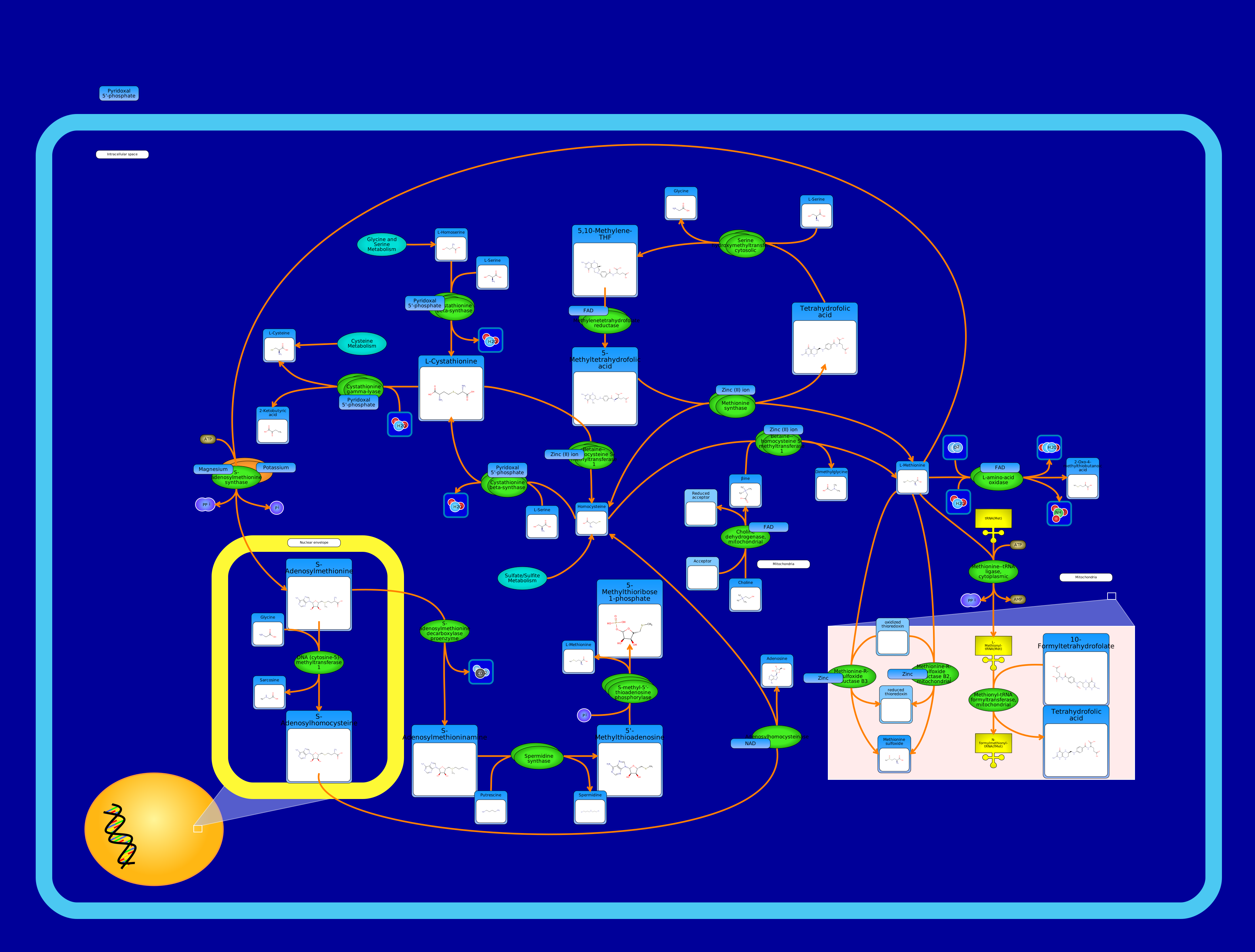 View Pathway
|
MethionineHomo sapiens
|
Metabolite
Metabolic
|
|
|
SMP0728409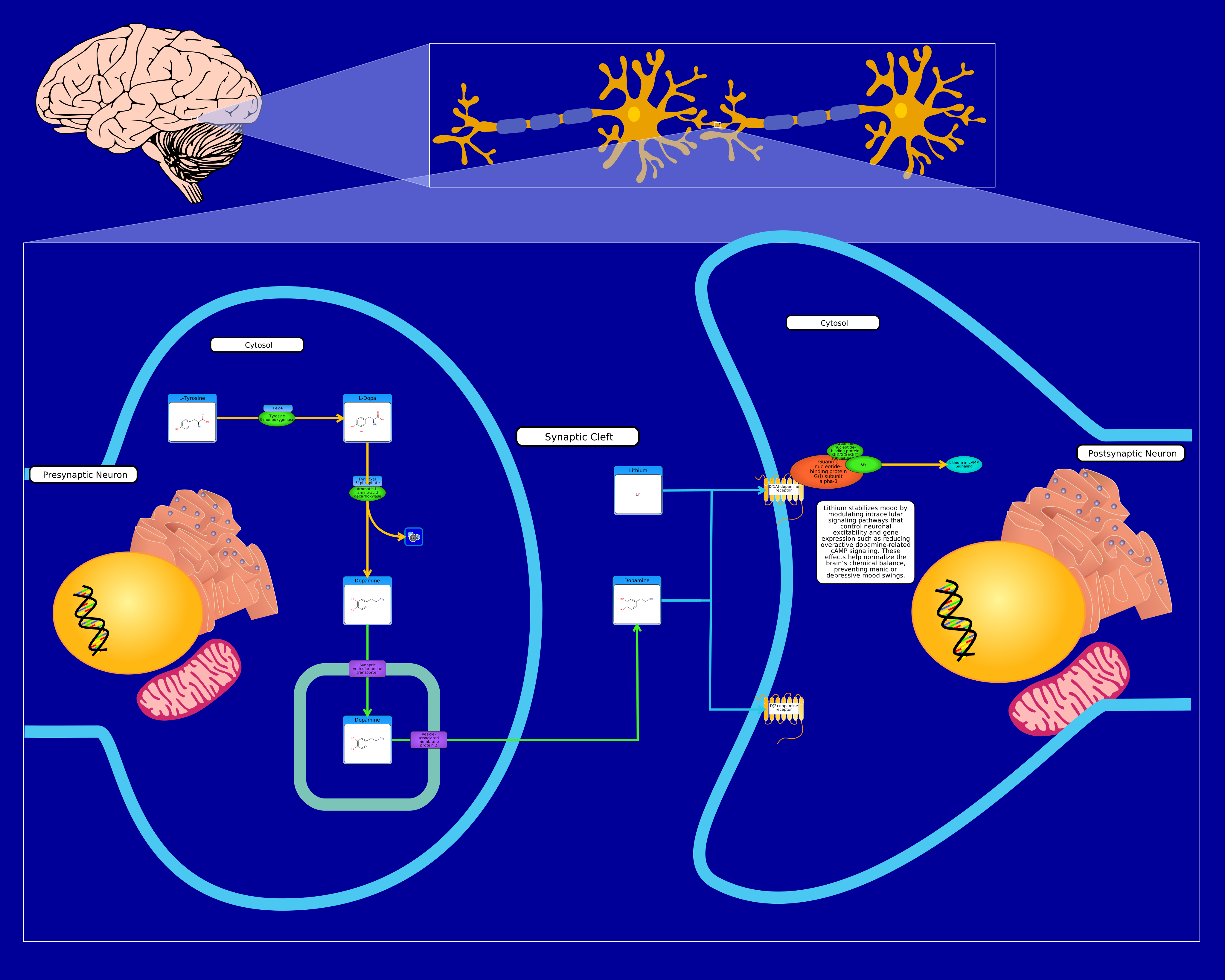 View Pathway
|
Lithium in Dopaminergic synapse activationHomo sapiens
Dopaminergic synapse activation occurs when an action potential reaches the axon terminal of a dopamine-releasing (dopaminergic) neuron, triggering the release of dopamine into the synaptic cleft. This process begins as voltage-gated calcium channels open, allowing calcium ions to flow into the presynaptic terminal. The influx of calcium causes synaptic vesicles filled with dopamine to fuse with the presynaptic membrane and release their contents into the cleft through exocytosis. Dopamine molecules then diffuse across the synaptic cleft and bind to specific dopamine receptors (such as D1-like or D2-like receptors) on the postsynaptic membrane, leading to either excitatory or inhibitory effects depending on the receptor subtype and neural context. This tightly regulated cycle ensures precise modulation of neural signaling related to movement, reward, motivation, and cognition. Lithium is a known mood stabilizer and drug administered for the treatment for bipolar disorder. It is known to interact with dopamine signaling and reduce dopamine levels in the brain through its interactions with the downstream pathway of the D1 receptor.
|
Metabolite
Signaling
|
||
SMP0729212
View Pathway
|
MitophagyHomo sapiens
|
Metabolite
Disease
|
|
|
SMP0729207
View Pathway
|
ImmunoTHHomo sapiens
|
Metabolite
Disease
|
|
|
SMP0288727 View Pathway
|
COX 1721988433Homo sapiens
|
Metabolite
Drug Action
|
|
|
SMP0729326
View Pathway
|
(KDO)2-[(3R)-3-hydroxymyristoyl, palmitoleoyl]-hexa-acylated lipid A BiosynthesisEscherichia coli
The biosynthesis of -Lipid A in Escherichia coli follows the highly regulated Raetz pathway, beginning in the cytoplasm where UDP-N-acetylglucosamine acyltransferase (LpxA) catalyzes the first committed step by adding a -3-hydroxymyristoyl chain from an acyl carrier protein (ACP) to UDP-GlcNAc. This product is then deacetylated by LpxC, followed by a second acylation at the -position by LpxD, forming a UDP-diacylglucosamine monomer. A portion of these monomers is hydrolyzed by LpxH to generate Lipid X (-bis[(3R)-3-hydroxymyristoyl]--D-glucosaminyl 1-phosphate), which is subsequently condensed with a remaining UDP-diacyl-GlcN molecule by Lipid A disaccharide synthase (LpxB) to form the -linked disaccharide backbone. This backbone is phosphorylated by LpxK to produce the tetra-acylated precursor Lipid . Before any secondary acylation can occur, two KDO sugars are sequentially added by the KDO transferase (WaaA) using CMP-KDO, resulting in -Kdo-(2→4)--Kdo-(2→6)-Lipid .
From this core, the molecule undergoes "late" acylation to reach its mature forms. Under standard conditions, the 5th position (the primary chain) is acylated with a Lauroyl (C12:0) chain by LpxL, forming the intermediate -(lauroyl)-Lipid (penta-acylated). This is immediately followed by the addition of the 6th tail, a Myristoyl (C14:0) chain, to the primary chain by LpxM, completing the canonical Hexa-acylated -Lipid A.
However, E. coli exhibits structural plasticity through specific fatty acid substitutions: in response to cold shock, the enzyme LpxP replaces the 5th-position laurate with Palmitoleate (C16:1) to maintain membrane fluidity. Furthermore, under environmental stress or exposure to antimicrobial peptides, the enzyme PagP can add a Palmitate (C16:0) chain to the 2-position of the proximal sugar, resulting in a Hepta-acylated version. Crucially, while remains the exclusive primary chain, secondary positions (5th and 6th) are never naturally substituted with hydroxylated chains or in a wild-type system, ensuring the precise hydrophobic fit required for outer membrane integrity and TLR4 immune signaling.
|
Metabolite
Metabolic
|
|
Showing 541121 -
541130 of 541183 pathways